Walk up to most factory gates and you will find the same setup. A thick register, a pen tied to a string, and a security guard trying to write down details while a truck waits behind and three contract workers stand in line.
It works, until it does not.
Factories deal with a mix of people that offices never face. Contractors who come for a two-week job. Daily wage labourers who change from month to month. Drivers who arrive at odd hours. Auditors, vendors, machine engineers and government officials. Each group needs different checks, and the register treats them all the same.
Common Problems With Paper Based Factory Entry
Plant teams usually describe the same set of issues:
- Handwriting no one can read later. When you need an entry record from four months ago, finding it is guesswork.
- No real verification. A name and a phone number written by hand prove nothing.
- Attendance disputes. Contractor bills are questioned because nobody has clean in-time and out-time data.
- Vehicles going untracked. Trucks enter for material movement, but the log is thin or missing.
- Safety gaps. People reach the shop floor before anyone confirms they completed induction.
- Slow gates. Queues build up during shift change, and security spends the whole time writing.
A digital visitor management system fixes the root cause. It replaces the register with a structured record that is created once, checked at the gate, and available afterwards. That is the core idea of factory entry management, and the rest of this guide explains how each part works.
Contractor Onboarding and Verification
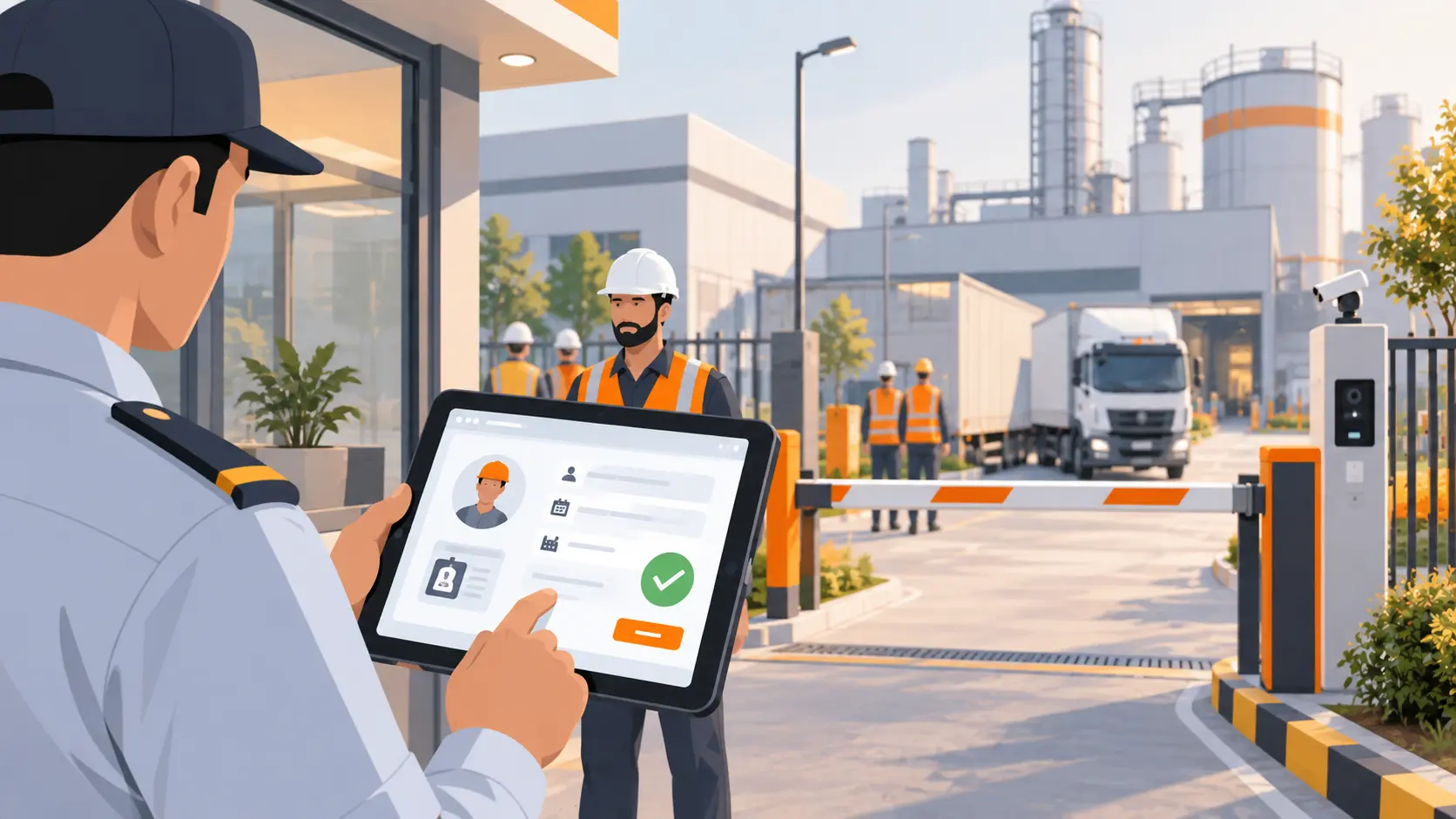
Contractors are the most demanding group at a factory gate, because they are not one-time visitors. They come back repeatedly, sometimes with their own teams, and they need to be treated as a managed group rather than a walk-in.
How Digital Contractor Registration Works
A contractor management system lets you register the contractor once and reuse that record for every visit. It typically captures the following during onboarding:
- Contractor details: company name, contact person, scope of work, work location inside the plant
- Identity verification: checking and recording ID proof at registration
- Documentation: storing the documents your plant requires before work begins
- Approval workflow: sending the request to the right internal person for clearance before entry is allowed
Once approved, the contractor and their workers do not start from zero every morning. The gate simply confirms the identity and lets them through.
Why Organised Contractor Records Matter
Digital records help two teams at the same time. Security teams get a fast answer to one question: is this person cleared to be here today? They are not flipping through a register or calling a department for confirmation. Administrative teams get something different. They get a searchable history of which contractor came, for what work, for how long, and under whose approval. That makes internal coordination, review and record-keeping far less painful than paper filing.
Expert tip: Decide early which internal role owns contractor approval, whether that is HR, the concerned department head, or EHS. Contractor onboarding software is only as strong as the approval rule you configure inside it.
Labour Attendance Management
Contract labour attendance is where factories feel paper pain the most, because attendance connects directly to money. A digital system records labour entry and exit times as they happen at the gate. The person is identified, the entry is marked, and the exit is marked when they leave.
Who This Supports
- Contract workers who work on fixed-duration projects
- Temporary labourers whose team composition changes frequently
- Workforce monitoring across shifts, so administration can see who was on site
- Accurate attendance data that feeds internal review and coordination instead of relying on memory or manual sheets
Accurate labour attendance management matters for a simple reason. When the entry and exit data is clean, questions about headcount and working hours have a straight answer. When it is written by hand across several registers, every review turns into an argument.
Vehicle Entry and Exit Management
Factories are not only about people. Material moves constantly, and material moves on wheels. A vehicle entry management module handles trucks, delivery vehicles and supplier vehicles at the gate.
What a Digital Vehicle Log Records
| Detail Captured | Why It Helps |
|---|---|
| Vehicle number | Identifies the vehicle in any later record check |
| Driver details | Links a person to the vehicle at the gate |
| Entry time | Marks exactly when the vehicle came in |
| Exit time | Confirms the vehicle actually left, and when |
| Purpose or material reference | Connects gate activity to the reason for the visit |
Digital vehicle logs improve visibility at the gate in a very practical way. Instead of a guard remembering that a truck came around noon, you have a timestamped entry you can look up. This is especially useful for vehicles involved in material movement, where knowing which vehicle was on site, and for how long, supports coordination between the gate, stores and administration.
Safety Induction Before Entry
Industrial environments carry risks that an office lobby does not. Machinery, moving vehicles, restricted zones and hazardous areas are all part of daily plant life. A person who has not been briefed is a risk to themselves and to everyone around them. That is why safety induction management belongs inside the entry process, not beside it.
What a Digital System Can Do
- Record safety training and induction completion for contractors, labourers and drivers
- Link access to safety requirements, so entry approval reflects whether induction is done
- Maintain digital induction records that support your safety compliance documentation
The advantage is not just record-keeping. It is sequencing. Safety induction stops being a form somebody signs later and becomes a condition that sits in front of entry approval.
Common mistake: Treating induction as an HR-only formality. In practice it needs to be visible at the gate, because the gate is where entry is actually granted.
Offline Visitor Management Mode
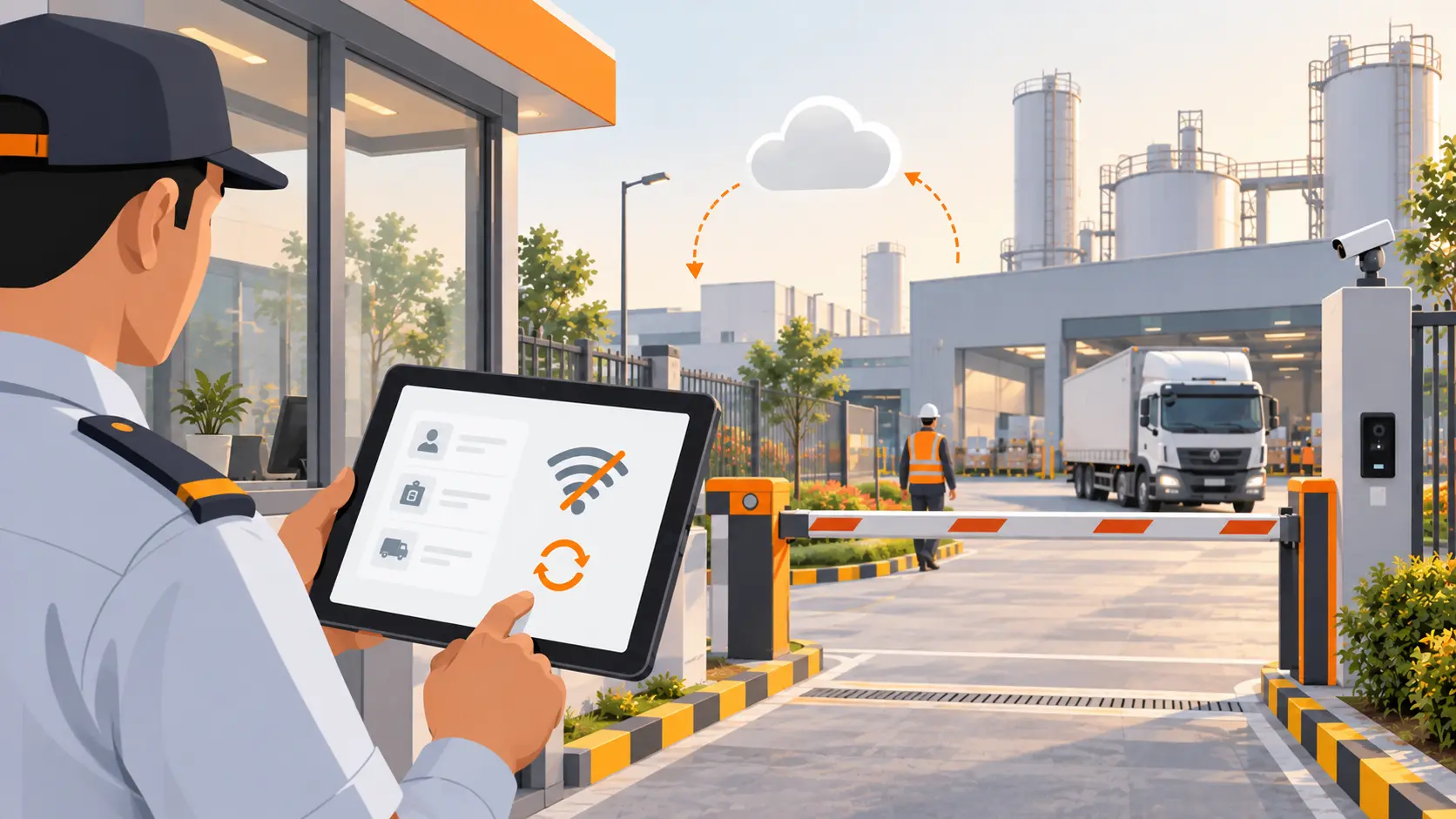
Here is a reality that software demos often skip. Many factories are located in industrial estates, on highways, or on the edge of a city, and internet connectivity there is not always dependable. If the network drops during a shift change, the gate cannot simply stop working.
An offline visitor management system mode is designed for exactly this. It allows entries to be recorded even when internet access is unavailable, so the gate keeps functioning and the record is not lost.
An Important Limitation
Data synchronisation behaviour depends on the system's own capabilities and configuration. How and when offline records sync back is a product-specific question. If your plant has connectivity problems, ask the vendor to explain their offline handling in detail rather than assuming it works a particular way.
Benefits of Digital Visitor Management in Factories
The benefits of a visitor management system in a plant setting are practical rather than dramatic.
| Benefit | What Changes on the Ground |
|---|---|
| Improved entry and exit visibility | You can see gate activity instead of reconstructing it |
| Better contractor record management | Contractor history is stored and searchable |
| Organised labour attendance tracking | In-time and out-time data is captured consistently |
| Easier vehicle monitoring | Vehicle logs are timestamped and retrievable |
| Improved safety process tracking | Induction status is recorded and linked to access |
| Reduced paperwork | Fewer registers, fewer physical files |
| Better security and admin coordination | Both teams work from the same record |
None of these are magic. They are the natural result of capturing entry data once, in a structured format, instead of writing it by hand in several places.
Digital vs Paper Factory Entry: Pros and Cons
An honest comparison helps more than a sales pitch. Both approaches have real trade-offs.
Paper Register at the Gate
Pros:
- No software cost and nothing to configure
- Works during a power cut or a network failure
- Any guard can use it on day one with no training
Cons:
- Records are hard to search and easy to lose
- Handwriting quality decides whether data is usable later
- No verification of the details written down
- Attendance and vehicle data cannot be reported on
- Safety induction status is not visible at the gate
Digital Visitor Management System
Pros:
- Entry data is structured, searchable and timestamped
- Contractor records are reused instead of rewritten daily
- Labour attendance and vehicle logs become reportable data
- Induction status can be checked before entry approval
- Security, HR and administration work from one record
Cons:
- Involves software cost and an initial setup effort
- Gate staff need basic training before rollout
- Needs a clear internal owner for approvals and permissions
- Depends on offline handling where connectivity is weak
- Fit varies widely between office-first and industry-ready products
How a Factory Visitor Management System Works
If you want the short version of how a visitor management system works at a plant gate, here is the flow: Contractor / Labour / Driver Arrives → Registration → Verification → Safety Check → Entry Approval → Digital Record → Exit Tracking.
Step by Step
- Arrival. A contractor, labourer or driver reaches the gate.
- Registration. Their details are captured, or their existing record is pulled up.
- Verification. Identity is checked against what was registered.
- Safety check. Induction or safety requirement status is confirmed.
- Entry approval. Access is granted based on the approval rules you set.
- Digital record. The entry is stored with its timestamp.
- Exit tracking. The exit is marked, closing the visit.
Who Uses the System
- Security personnel run the gate: register, verify, approve and mark exits.
- HR teams use contractor and labour attendance records for internal coordination.
- Factory administrators use reports and records for oversight, review and planning.
What to Consider Before Implementing a VMS
Not every visitor management software product is built for industrial use. Many are designed for office receptions, and a plant gate is a different world. Use this checklist while evaluating.
| Check | Question to Ask the Vendor |
|---|---|
| Contractor and labour management | Does it handle repeat contractors and changing worker teams, or only one-time guests? |
| Vehicle entry tracking | Can it record vehicle number, driver, entry time and exit time properly? |
| Safety induction support | Can induction status be recorded and linked to access? |
| Offline functionality | What happens at the gate when the internet is down? |
| User access permissions | Can security, HR and admin have different levels of access? |
| Reporting and record management | Can past records be retrieved easily and in a usable form? |
| Integration with existing systems | Will it sit alongside the systems the plant already runs? |
A caution worth repeating: Judge the system against your gate, not against a demo. Ask the vendor to walk through your actual scenarios: a truck at 2 AM, twelve labourers at shift change, a contractor whose induction expired.
Conclusion
Factory entry is not a formality. It is a daily operational process involving contractors, labourers, vehicles and safety obligations, all happening at one busy point on the premises.
A digital visitor management system brings order to that point. It records who came in, when they left, which vehicle carried what, and whether safety requirements were met before access was granted. That record then supports security, HR and administration without anyone needing to decode handwriting.
If your plant is still running on registers, the useful next step is not to rush into a purchase. It is to map your own entry scenarios, covering contractors, labour, vehicles, safety and connectivity, and then look for a system that answers those specific needs.
Explore how a visitor management system can support your factory's entry management needs, and start by asking how it handles your gate on your busiest day.
Key Takeaways
- A visitor management system for factory use goes far beyond signing in guests. It manages contractors, labour, vehicles and safety induction together.
- Contractor onboarding works best when registration, verification, documentation and approval happen once and are reused.
- Labour attendance management turns gate entry and exit into usable data instead of disputed handwriting.
- Vehicle entry management records vehicle number, driver, entry time and exit time, improving gate visibility for material movement.
- Safety induction should sit before entry approval, not after it.
- Offline mode matters in industrial locations, but sync behaviour depends entirely on the specific system's capabilities and configuration.
- Evaluate any visitor management software for factories against your real gate scenarios, not a generic office demo.