It’s 9:05 AM on a Monday. A candidate for a leadership interview is standing at the reception desk, watching the security guard flip through a battered register looking for a blank page. Behind her, two vendors and a courier are waiting their turn. The receptionist is juggling three phone calls, trying to find out which manager is expecting the vendors, while the host for the interview has no idea their candidate has even arrived.
This scene repeats itself every day in offices, factories, hospitals, and government buildings across the country. A visitor management system exists precisely to end it, replacing chaotic paper registers with a fast, secure, and professional check-in experience that protects people, data, and reputation.
This guide breaks down what a modern visitor management software actually does, why manual processes are failing organizations in 2026, and how a platform like VizMan helps businesses turn their front desk into a genuine first line of security and hospitality.
What Is a Visitor Management System?
A visitor management system is software that digitizes and automates every step of a visitor’s journey from pre-registration and identity verification to check-in, badge issuance, host notification, and eventual check-out. Instead of a handwritten logbook, visitors interact with a visitor sign-in app, a kiosk, or a QR code, while hosts and security teams get real-time visibility into who is on the premises at any given moment.
At its core, this is reception automation. But the scope has grown far beyond simply recording names. Today’s digital visitor register also handles contractor and vendor entries, courier drop-offs, meeting scheduling, and even emergency evacuation tracking making it a central nervous system for facility operations rather than a standalone gadget at the front desk.
Why Manual Visitor Logs Are No Longer Enough
Paper registers were adequate when offices were smaller, threats were fewer, and no one asked questions about data privacy. That world doesn’t exist anymore.
The Core Problems with Manual Registers
- Illegible or fake entries: Anyone can write anything including a false name and no one verifies it.
- No real audit trail: Retrieving visitor history for a specific date, especially months later, means flipping through stacks of paper.
- Security blind spots: There’s no way to instantly know who is inside the building during a fire drill or a genuine emergency evacuation.
- Slow, frustrating experience: Long queues at reception create a poor first impression for clients, partners, and job candidates alike.
- Compliance risk: Industries like manufacturing, healthcare, and government are increasingly required to demonstrate visitor compliance and identity verification something a paper log simply cannot support.
Consider a mid-sized factory that receives dozens of contractors, drivers, and daily wage workers every shift. Without a reliable visitor tracking system, the safety officer has no accurate headcount if an incident occurs on the floor. That’s not just an inconvenience, it’s a genuine liability.
The Business Impact of Getting This Wrong
The cost of outdated visitor processes rarely shows up as a single line item, which is exactly why it gets ignored. It shows up as:
- Reception staff spending hours on manual data entry instead of hosting guests.
- Hosts missing visitor arrivals because there’s no employee notifications system in place.
- Security teams unable to answer basic questions during audits or incident investigations.
- A brand impression that feels dated compared to competitors who’ve already modernized.
For growing organizations, workplace productivity and corporate security are no longer separate conversations; they intersect directly at the front door.
There’s also a talent and reputation angle that’s easy to overlook. A candidate who waits fifteen minutes at an unmanaged front desk forms an opinion about the company before the interview even starts. A visiting investor who watches a receptionist struggle to locate a paper entry may quietly question how well the organization runs its other operations. First impressions at reception ripple outward into hiring decisions, partnership conversations, and client trust in ways that rarely get tracked but consistently matter.
What a Modern Visitor Management Software Should Do
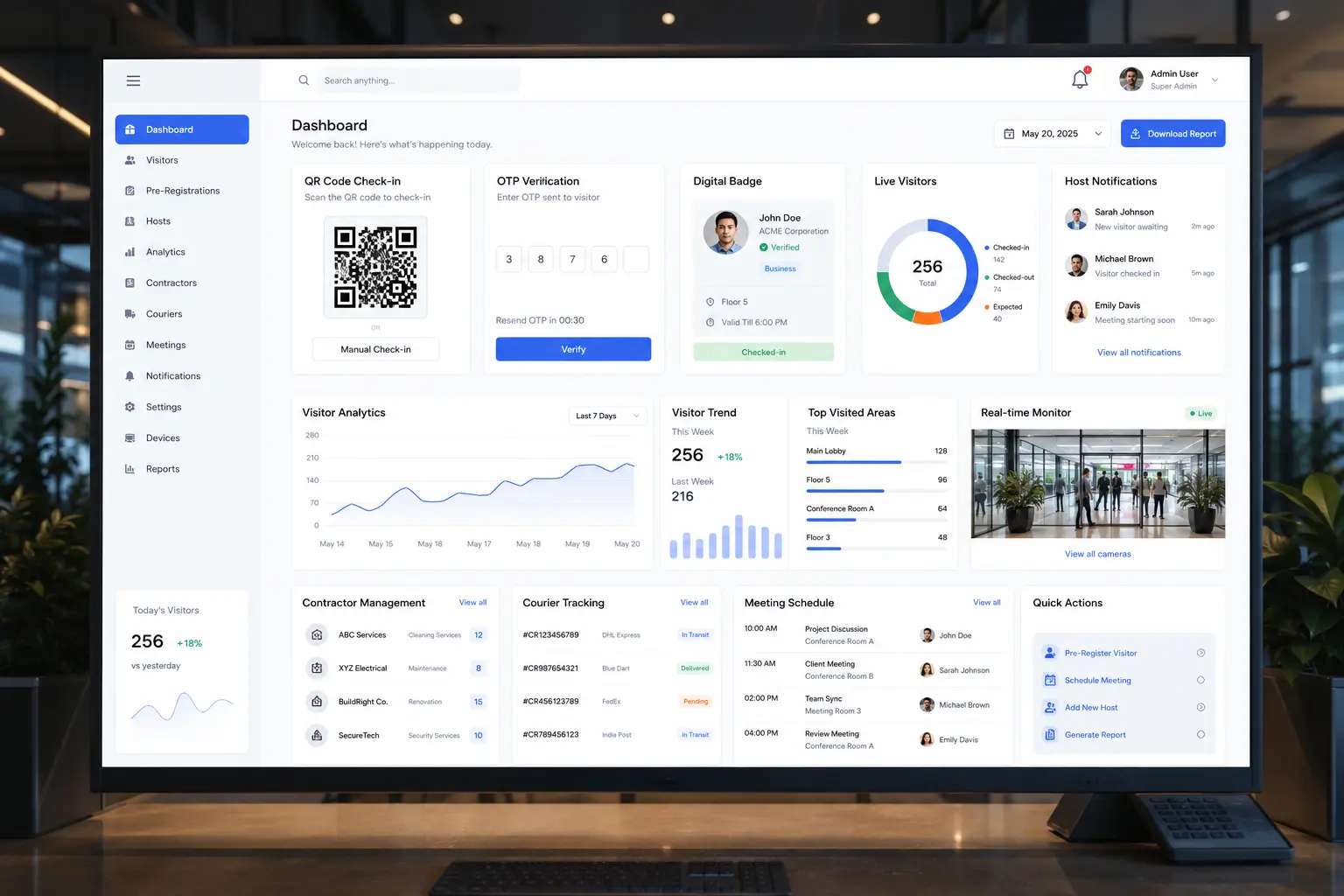
A capable office visitor management platform needs to handle the entire visitor lifecycle, not just the moment of arrival. Here’s what that typically looks like in practice.
Pre-Registration and Identity Verification
Hosts can invite visitors in advance, sending them a QR code or link. On arrival, identity verification often through OTP-based mobile authentication confirms the person is who they claim to be before they’re allowed past reception.
Contactless Visitor Check-In
QR code visitor management lets guests check themselves in within seconds by scanning a code at a kiosk or tablet, cutting queue times dramatically. This contactless visitor check-in approach also matters for hygiene-conscious environments like hospitals and co-working spaces.
Visitor Badge Printing and Digital Passes
Once verified, visitors receive a printed badge or an ePass with their name, photo, host, and time of entry clearly displayed. Visitor badge printing gives security staff an easy, visible way to confirm who belongs in restricted areas.
Real-Time Employee Notifications
The moment a guest checks in, the host receives an instant alert no more phone tag with the front desk. This single feature alone eliminates one of the most common complaints about traditional reception.
Contractor and Vendor Management
Contractor management and gate pass management modules track recurring vendors, delivery staff, and daily workers separately from one-time guests, often with different approval workflows and access rules.
Courier Management
Every parcel and courier drop-off gets logged and matched to the intended recipient, closing a gap that most manual systems leave completely unmanaged.
Meeting Scheduling
Integrated meeting scheduling lets hosts block time, invite external guests, and automatically trigger the check-in workflow connecting the calendar directly to the reception desk.
Dashboards and Visitor Analytics
Visitor analytics give facility managers visibility into peak visiting hours, average wait times, and repeat visitor patterns data that used to be invisible in a paper-based world.
Industry Use Cases: Where This Matters Most
- Corporate offices rely on digital reception to project professionalism to clients and protect confidential work areas from unauthorized entry.
- Manufacturing plants need airtight contractor management and gate pass tracking, since dozens of external workers may move through the facility daily under strict access control rules.
- Hospitals use visitor systems to manage patient visitors without adding pressure to already-stretched front-desk staff, while keeping restricted wards secure.
- Schools and colleges replace paper logbooks with systems that instantly verify parents and visitors against approved lists, a critical safeguard for student safety.
- Warehouses manage a constant flow of drivers and delivery personnel, where fast, accurate check-in directly affects loading dock efficiency.
- Government offices need audit-ready records and strict identity verification, often for compliance with public-sector security mandates.
- Co-working spaces juggle multiple tenant companies under one roof, each needing their own guest lists, notifications, and access rules.
- Commercial buildings with shared lobbies use centralized systems so multiple tenant organizations can each manage their own visitors through one platform.
A Step-by-Step Look at the Modern Visitor Workflow
- Pre-registration: The host or admin adds visitor details in advance, or the visitor self-registers via a link.
- Arrival and verification: The visitor scans a QR code or enters an OTP sent to their phone.
- Instant host alert: The system sends a notification the moment check-in is complete.
- Badge or ePass issuance: A badge prints automatically, or a digital pass appears on the visitor’s phone.
- Access and escort: Security or reception directs the visitor based on their pre-approved access level.
- Check-out and logging: Exit time is recorded automatically, completing the audit trail.
This entire sequence, which used to take several minutes of manual paperwork, now typically takes under a minute, a meaningful gain in business efficiency when multiplied across dozens of daily visitors.
Security, Compliance, and Data Privacy
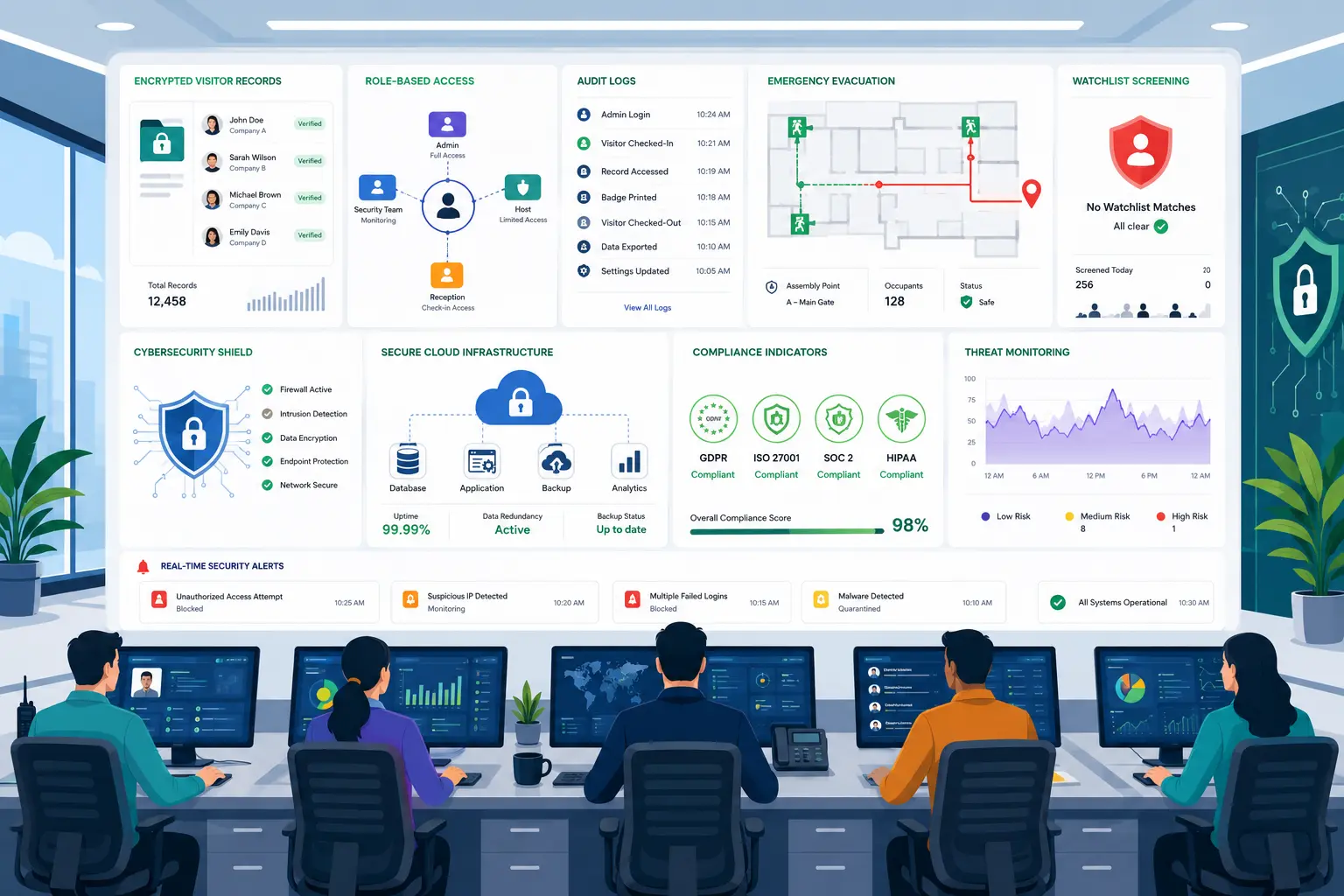
Enterprise security conversations increasingly start at the front door. A serious visitor registration software platform should offer:
- Encrypted storage of visitor data, aligned with data privacy regulations.
- Role-based access so only authorized staff can view sensitive visitor information.
- A complete, timestamped audit trail for every check-in and check-out.
- Watchlist screening to flag denied or blacklisted individuals automatically.
- Evacuation reports that generate an instant list of everyone on-site during an emergency.
These aren’t optional extras anymore they’re baseline expectations for any organization serious about corporate security and regulatory readiness.
Integration Capabilities
A visitor system shouldn’t operate as an island. The best platforms integrate with:
- Access control and turnstile hardware, so verified visitors can move through gates automatically.
- Calendar tools, syncing meeting invites directly with check-in workflows.
- HR and directory systems, keeping employee and host information up to date.
- Communication tools, so employee notifications land wherever the host actually works email, SMS, or app.
This kind of connected ecosystem is a meaningful part of broader digital transformation efforts, rather than a one-off tool bolted onto reception.
Consider a corporate campus with a badge-controlled turnstile at the main entrance. Without integration, a security guard has to manually issue a separate access card after a visitor has already checked in digitally creating a redundant step and a gap where records can fall out of sync. When the visitor management software talks directly to the access control hardware, a verified guest’s digital pass unlocks the turnstile automatically, and the moment they exit, both systems update together. That kind of tight integration is what separates a genuinely modern platform from a check-in app that happens to run in the cloud.
ROI and Business Value
The return on a reception management software investment tends to show up in a few concrete ways:
- Time savings for reception and security staff, who no longer manage paperwork manually.
- Reduced risk from unverified or unauthorized entries.
- Better compliance posture during audits, thanks to instantly retrievable records.
- Improved employee experience, since hosts aren’t interrupted with phone calls every time a guest arrives.
- Stronger first impressions for clients, investors, and candidates a factor that’s easy to underestimate but genuinely affects brand perception.
For most mid-to-large organizations, these gains pay back the cost of the software within the first few months, particularly when reception staff time and security incident costs are factored in.
Where Visitor Management Is Headed
Looking ahead, a few trends are shaping how cloud software in this space evolves:
- Deeper mobile accessibility, with more organizations relying entirely on visitors’ own smartphones rather than dedicated kiosks.
- AI-assisted verification, using facial recognition or document scanning to speed up identity checks further.
- Unified facility platforms, where facility management, vendor management, and visitor tracking sit inside one dashboard rather than separate tools.
- Predictive analytics, helping facility teams anticipate peak visitor times and staff reception accordingly.
Organizations that adopt these capabilities early tend to build a meaningful operational advantage over competitors still relying on a logbook and a pen.
No Credit Card Required!
Start Your Free Trial Today
Experience all the amazing functionalities of VizMan with our 14-day free trial. No commitment, full access to all features.
Register Now
Why VizMan Is Built for This Moment
VizMan approaches visitor management as a complete front-desk operating system rather than a single check-in screen. It combines OTP-based verification, role-based access for admins, security, reception, and hosts, and instant badge or ePass issuance into one straightforward workflow. Meeting scheduling and courier management are built in alongside visitor check-in, so reception teams aren’t juggling separate tools for related tasks. A live dashboard gives facility managers the visitor analytics they need to spot patterns and plan staffing, while encrypted data handling supports the security and compliance standards that corporates, hospitals, factories, schools, and government offices all depend on.
Because it’s cloud-based, VizMan works across industries with very different needs from a warehouse tracking daily drivers to a co-working space managing multiple tenant companies under one roof without forcing any of them into a rigid, one-size-fits-all process.
Bringing It All Together
The front desk is no longer just a place to say hello. It’s where security, compliance, and first impressions all meet and where outdated paper processes quietly cost organizations time, safety, and credibility every single day.
A modern visitor management system doesn’t just replace a logbook; it gives organizations real visibility into who is on their premises, protects sensitive areas, and frees reception staff to actually focus on hospitality instead of paperwork.
If long queues, missed notifications, or compliance gaps sound familiar, it may be time to see what a purpose-built platform can do for your front desk.