A visitor management system replaces paper registers with digital check-in, QR codes, host notifications, and audit-ready visitor records. It cuts wait times, closes security gaps, and gives businesses real-time visibility into who is on their premises something a notebook at the front desk simply cannot do. This guide covers how these systems work, the features that matter, industry use cases, and what to evaluate before you buy.
It's 9:15 AM, and the Lobby Is Already a Problem
A delivery contractor is arguing with the security guard about who he's here to see. Two job candidates stand awkwardly near the door because the receptionist is on a call. Somewhere in a drawer is a spiral register with yesterday's entries half illegible, none searchable.
Then the phone rings. It's the facility manager. There was an incident near the loading dock last night, and someone needs to know exactly who entered between 6 and 9 PM. The register shows three entries. Two of the handwriting samples look identical. Nobody remembers checking IDs.
This isn't a rare, dramatic scenario it's an ordinary Tuesday at thousands of offices, factories, and retail locations. Long queues, guessed names, unauthorized entries, and a register nobody can actually use when it matters: these are the quiet, everyday failures of manual visitor tracking, and they compound every day a business relies on pen and paper.
This guide walks through why that happens, what it costs a business, and how a modern visitor management system solves it not by adding more process, but by removing the friction altogether.
What Is a Visitor Management System?
A visitor management system (VMS) is software that digitizes the entire visitor journey from pre-registration and QR-code check-in to host notification, badge printing, and check-out replacing the paper register at the front desk.
Instead of writing a name, phone number, and "purpose of visit" into a notebook, a guest checks in through a tablet, kiosk, or QR code. The system captures their photo, verifies identity if needed, and instantly notifies the person they're there to see. When they leave, they check out digitally, and the entire visit start time, end time, host, purpose becomes a searchable record.
Think of it as the difference between a filing cabinet and a search bar. The information a paper register holds isn't wrong, exactly it's just locked away, illegible half the time, and useless the moment you need it in a hurry.
Why Manual Visitor Registers No Longer Work
Paper registers were never designed for the scale, speed, or security expectations of a modern workplace. They bring:
- Human error illegible handwriting and skipped fields
- Lost or damaged registers years of history held in one notebook
- Fake or vague entries "John, Vendor" tells you almost nothing
- Slow check-ins no way to speed up a manual process
- No real security check nobody verifies that "John" is who he says he is
- Zero live tracking no visibility into who's currently on-site
- Compliance gaps no reliable audit trail since entries can be altered after the fact
- Data privacy risk any visitor can read another visitor's details
- Poor visitor experience overall friction from arrival to exit
Individually, these look like minor inconveniences. Together, they represent a business operating blind at its own front door.
The Hidden Cost of Manual Visitor Management

Most businesses don't calculate what paper-based check-in actually costs them, because the costs are scattered rather than itemized on an invoice.
Reception delays pull receptionists away from other work every time a line forms, and lost productivity shows up when employees leave their desks to escort or search for visitors who couldn't be located. Security incidents, even minor ones, like an unescorted visitor in a restricted area, carry investigation time and, at worst, liability.
There's also the paperwork itself, employee interruptions from unannounced visitors, and operational inefficiency that compounds across every additional site. Compliance failures during an audit carry real financial and reputational consequences, and a chaotic lobby is often a visitor's first impression of the brand they're about to do business with. None of these costs show up as a single line item which is exactly why they're so easy to ignore, and so expensive to keep paying, quietly, every day.
Why Modern Businesses Are Switching to Digital Visitor Management
The shift toward digital check-in isn't just about looking modern. It delivers measurable operational gains:
- Automation removes manual data entry
- Contactless check-ins reduce shared touchpoints
- Faster approvals mean hosts are notified instantly rather than five minutes later
- Cloud accessibility lets facility managers check activity from anywhere
- Visitor analytics turn check-in data into patterns like peak hours
- Consistent identity capture drives real security improvements
- Multi-location management gives a single dashboard view across every site, since the same system scales from one office to fifty closing an operational gap paper simply cannot fill at scale
How a Modern Visitor Management System Actually Works
The visitor journey typically follows a clear sequence:
- Pre-registration by the host
- Visitor invitation and QR code generation for that visit
- Self check-in at a kiosk on arrival
- Instant host notification and, if required, badge printing
- Visitor tracking while on-site
- Digital check-out on departure
- The full visit becomes searchable visitor analytics
Pre-registration alone eliminates the "who are you here to see?" conversation that slows down every unannounced arrival.
Key Features Every Business Should Look For
Not every visitor management system needs every feature, but understanding what each one does for the business helps you evaluate options with more than a checklist mindset.
- QR Code Check-in skips the front-desk queue for pre-registered visitors
- Digital Reception reduces dependence on one receptionist for every check-in
- Badge Printing gives security an instant visual for approved visitors
- OTP Verification confirms a phone number before on-site access
- Photo Capture creates a verifiable record tied to each visit
- ID Verification adds identity assurance for sensitive facilities
- Approval Workflow no visitor enters without explicit approval
- Host Notifications removes the delay between arrival and host awareness
- Visitor Analytics turns check-ins into insight on peak hours and repeat visitors
- Emergency Evacuation List real-time headcount during a drill or emergency
- Blacklist Management automatically flags previously denied individuals
- Repeat Visitor Recognition speeds up check-in for regular vendors
- Multi-location Support centralizes data across every branch
- Cloud Dashboard real-time visibility without being on-site
- Access Logs records exactly who entered, when, and where
- Visitor Reports turns logs into shareable management summaries
- Compliance Records maintains audit-ready documentation
- Mobile Accessibility lets hosts track visitors from their phone
Industry-Specific Use Cases
Visitor management needs look different depending on the environment. Offices, retail shops, and factories each face a distinct version of the same core problem, and VizMan is built to adapt to all three.
VizMan for Corporate Offices
An office lobby has to manage several types of traffic at once: client meetings, job interviews, vendor visits, and delivery personnel often all within the same hour. When check-in depends on a single receptionist and a printed visitor list, delays and awkward waiting-room moments are almost guaranteed, especially during back-to-back meeting blocks.
With VizMan, a host can pre-register a visitor before they even leave for the office, generating a unique QR code that's sent directly to the guest. When they arrive, they scan the code at a self-check-in kiosk or tablet no queue, no handwritten form. VizMan captures their photo, prints a badge if the organization requires one, and sends an instant notification to the host's phone or desktop, so the visitor isn't left standing in the lobby wondering if anyone knows they've arrived.
For offices with multiple meeting rooms or floors, VizMan's approval workflow means security or reception can confirm a visitor's purpose before they're allowed past the front desk, useful for interview candidates, external auditors, or anyone who shouldn't have unsupervised access to internal areas. Over time, the cloud dashboard gives office administrators a clear picture of visitor volume by day and hour, which helps with everything from reception staffing decisions to planning meeting room availability. For offices spread across multiple locations, VizMan's multi-location support consolidates all of this into a single view, so a facilities or admin team doesn't have to check five separate systems to know what's happening across the company.
VizMan for Retail Shops
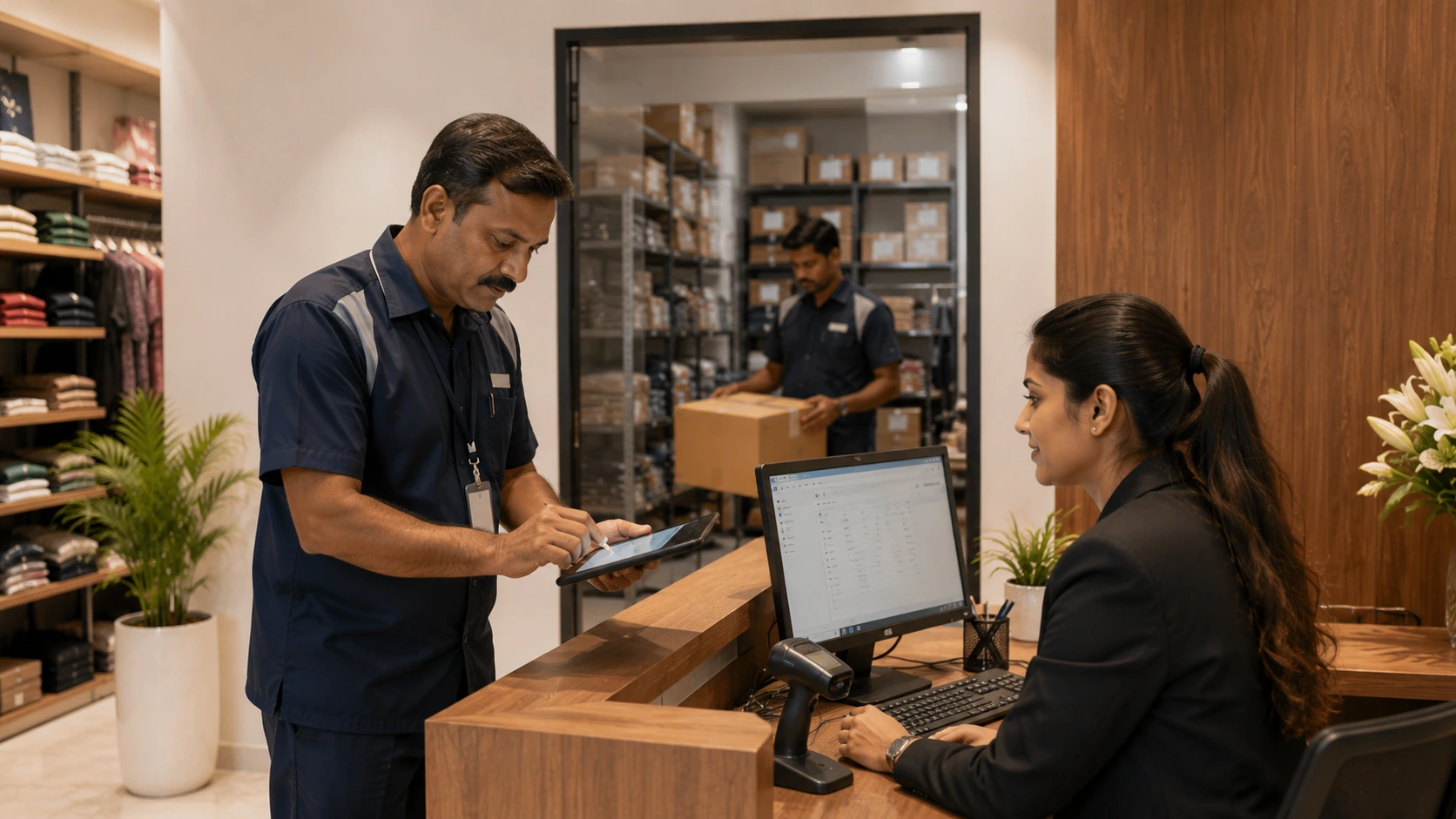
Retail locations deal with a visitor category that's easy to overlook: not customers, but the vendors, merchandisers, delivery staff, and third-party contractors who need access to stock rooms, back offices, and staff-only areas. A busy store often has no formal process for this at all. Someone in a uniform walks in, a staff member assumes they're legitimate, and there's no record of who was actually in a restricted area or when.
VizMan gives retail businesses a way to formally separate this traffic from customer footfall. Vendors and delivery personnel can be pre-registered by a store manager or checked in on arrival through a tablet at the back entrance, with their visit logged separately from the shop floor. Badge printing and photo capture mean staff can visually confirm that the person walking into the stock room matches an approved, checked-in visitor a meaningful loss-prevention improvement over simply trusting a uniform or a name.
For retail chains with multiple outlets, VizMan's centralized dashboard lets a regional or operations manager see vendor visit patterns across every store: how often a particular supplier visits, which stores get merchandiser traffic on which days, and whether any location has unusual after-hours activity. Blacklist management also matters here: if a vendor representative or contractor is flagged at one location, that flag can apply across the entire retail network, rather than being isolated knowledge held by a single store manager.
VizMan for Factories
Factories carry the highest stakes of the three, because visitor management there isn't just about convenience; it's tied directly to safety compliance and operational security. Contractors, auditors, raw material suppliers, and equipment technicians move through a facility constantly, and each of them may need a different level of access, safety briefing, or documentation before they're allowed onto the floor.
VizMan lets factory administrators build approval workflows that reflect this reality. A visitor can be required to acknowledge a safety induction or briefing as part of check-in, with that acknowledgement logged as part of their visit record, giving the facility a documented answer if a safety officer or auditor later asks whether a specific contractor was briefed before entering. ID verification and photo capture add a layer of assurance for facilities that need to confirm a visitor's identity against a pre-approved list, rather than relying on a gate register entry that anyone could have written.
The emergency evacuation list is particularly valuable in a factory setting: if there's an incident on the floor, VizMan can produce a real-time list of exactly who is on-site employees and visitors alike instead of security staff trying to reconstruct headcount from a logbook during an active emergency. And because factories often deal with repeat contractors and suppliers, repeat visitor recognition speeds up routine check-ins without lowering the verification standard for first-time visitors.
Other Environments VizMan Supports
- Manufacturing Plants: safety briefings and induction acknowledgement before floor access, with documentation to prove it happened
- Warehouses: pre-registration and QR check-in keep high-volume dock traffic moving without a bottleneck at one gate register
- Hospitals: digital check-in tracks who visited which ward and when, supporting security and infection-control protocols
- Educational Institutions: schools need to know, at all times, which adults are on campus and why
- IT Parks: multi-tenant buildings route visitors to the correct company and floor without confusion
- Coworking Spaces: constant member turnover is easier to manage without checking every face against a membership list manually
Security Benefits of Digital Visitor Management
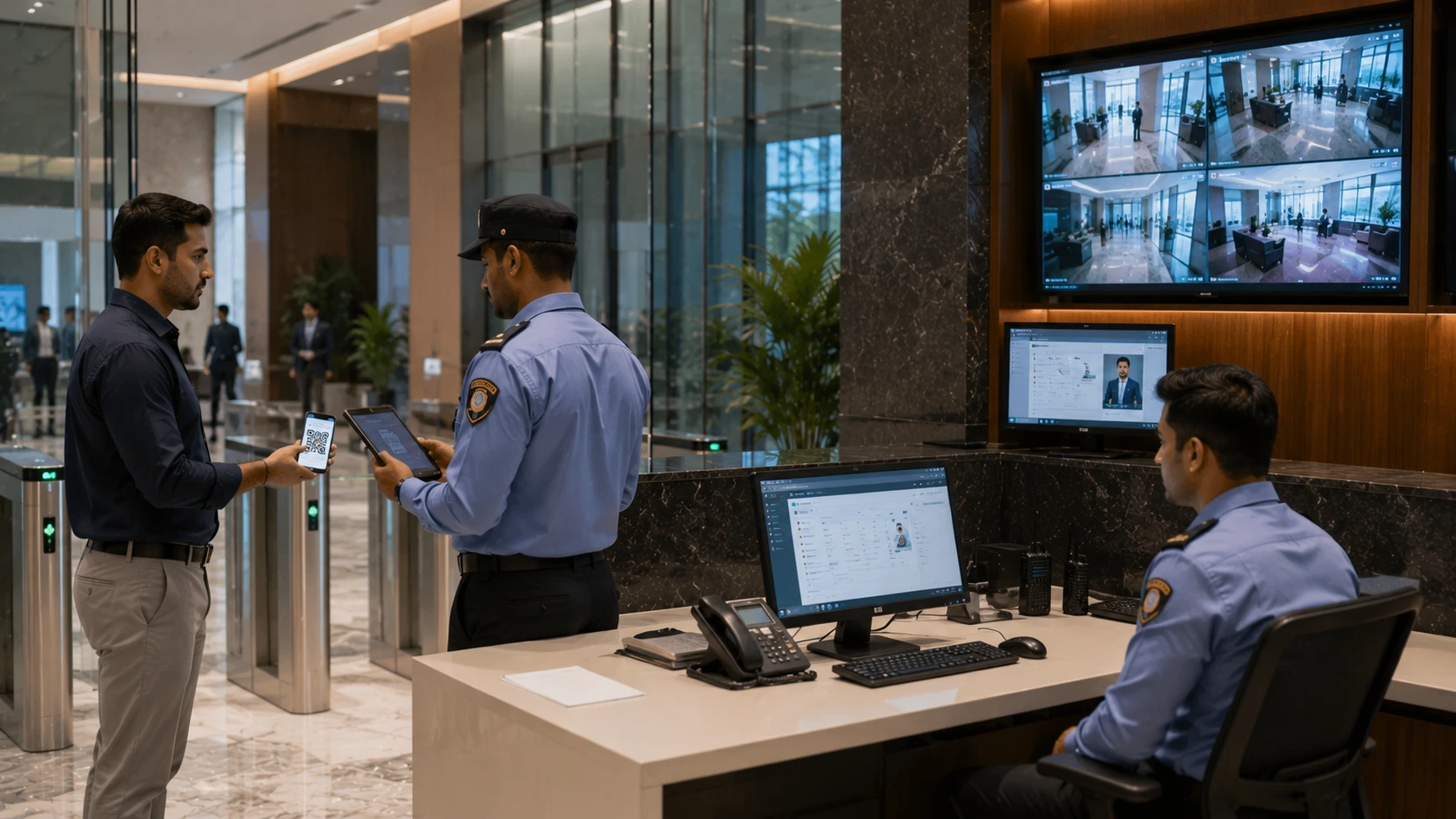
The security case for digital check-in goes beyond "looking more professional." It brings:
- Unauthorized access prevention through approval workflows
- Visitor verification via photo capture, OTP, or ID checks
- Digital records that can't be altered or misplaced like paper
- Audit trails that hold up under questioning
- Real-time monitoring of who's on-site right now
- Accurate emergency evacuation headcounts
- Ongoing compliance readiness for regulated industries
Productivity Benefits: What Actually Improves Day to Day
Security often gets top billing, but daily productivity gains are where most businesses feel the change first: reduced wait times, a faster reception workflow that doesn't depend on one person, and less paperwork to manage overall. Employees get better focus with fewer walk-up interruptions, and visitors get a smoother arrival, which shows up directly in visitor satisfaction.
Compliance and Data Privacy: What to Expect
Any system capturing visitor names, contact details, and photos is handling personal data and that comes with responsibility. A well-built platform should support clear data handling practices, consent captured at check-in, audit-ready records, secure digital storage instead of paper in a drawer, role-based access, and retention policies defining how long data is kept.
Compliance requirements vary by industry and region, and no software alone guarantees legal compliance that depends on how an organization configures and uses it. A good VMS makes responsible data handling easier; it doesn't handle every legal obligation on your behalf.
Why VizMan Stands Out
Once you understand what a visitor management system needs to do fast check-in, real security, clean compliance records, and a better visitor experience the question becomes which platform delivers that without adding complexity of its own.
VizMan, built by Naapbooks, is a cloud-based visitor management platform designed for businesses that want to deploy quickly and scale without friction. It offers easy deployment with no lengthy IT rollout, a cloud-based platform accessible from any location, and a modern UI that front-desk staff and hosts can pick up with minimal training. It's built to scale from a single-office business today to multiple locations tomorrow, with real-time dashboards that show visitor activity as it happens rather than after the fact, and fast implementation from signup to first check-in.
VizMan also supports role-based access for admins, gatekeepers, receptionists, and employees, so each person only sees and manages what's relevant to their job a small but meaningful security improvement over a shared paper register anyone can read.
Before and After: What Actually Changes
| Scenario | Before Digital Check-in | After VizMan |
|---|---|---|
| Contractor arrival | Manual entry, phone call to confirm legitimacy, guard relying on memory | Pre-registration through a host link, QR code scan, photo capture |
| Verification | Guard takes someone's word for it | Department head gets an instant notification and sees an approved, verified entry on screen |
| Audit request | Manual search through a stack of notebooks | A filtered report generated in seconds |
The change isn't just faster it's a fundamentally different level of control over who is inside the building at any given time.
The Future of Visitor Management
Visitor management is moving further away from a simple check-in log and toward something closer to an intelligent access layer for the workplace. AI-powered reception is starting to handle routine visitor queries without human intervention, while smart workplace automation connects visitor systems with meeting rooms, elevators, and access control. Facial recognition, where privacy regulations and policy allow it, is enabling faster verified entry, and touchless experiences continue to minimize shared surfaces and manual steps. Looking further ahead, predictive visitor analytics will help facilities teams plan staffing around expected volume, as visitor, meeting, and space management increasingly operate as one connected workplace ecosystem rather than separate tools.
These aren't universal requirements for every business today, but they show where the category is headed and why a cloud-based, actively developed platform matters more than a static, feature-frozen tool.
Conclusion
The problems that opened this guide the queue at 9:15 AM, the illegible register, the frantic call asking who was on-site last night aren't isolated incidents. They're the predictable result of relying on paper for a job that now requires speed, accuracy, and accountability.
A visitor management system doesn't just digitize a notebook. It replaces guesswork with verification, delay with instant notification, and an unsearchable stack of paper with a record you can produce when it matters during an audit, an emergency, or just a busy Tuesday morning. If your front desk is still running on a pen and a register, the cost isn't hypothetical: it shows up in wasted time, security gaps, and every visitor forming a first impression of your business while standing in a line.
Ready to see what a modern check-in experience looks like for your business? Book a demo with VizMan or explore VizMan's Visitor Management System to see how it fits your industry.