


A contractor safety induction is a documented, site-specific briefing every contract worker completes before entering a plant, covering site hazards, emergency procedures, PPE and permit rules. Compliance tracking is the system that records who has been inducted, when it expires, and which statutory documents are still valid and enforces that at the gate.
Here is the gap that keeps EHS managers awake.
Your safety manual says every contract worker is inducted, medically fit, PF-enrolled and badged. Your induction register agrees. Then it is 6:00am at Gate 2, a shutdown is running, 140 contract workers are queued, and a contractor supervisor is vouching for six faces the guard has never seen. The register gets filled in at 9:00. Three of those workers have medical fitness certificates that lapsed in March.
Nobody in that chain is acting in bad faith. The system just was not designed for shift change.
This guide covers what the induction must contain, what documents need tracking, how validity should behave at the gate, and how to build audit evidence you do not have to reconstruct later.
Who counts as a contract worker at your gate?
Anyone working on your premises under a contractor’s employment rather than yours. Most plants under-count this, and under-counting is where audit findings start.
Your gate sees four distinct populations, and they need different treatment:
- Regular contract workforce housekeeping, canteen, security, material handling, packing. On site daily, often for years. Highest volume, lowest per-visit scrutiny, which is exactly backwards.
- Project and shutdown labour fabrication, painting, insulation, civil, erection crews. High hazard, short duration, large numbers, frequently first-time on your site.
- Specialist service technicians OEM engineers, calibration teams, lift and crane servicing, DG set and transformer vendors. Low volume, high competency requirement, often working alone on live equipment.
- Transporters and drivers arguably the most under-inducted group in Indian plants. They enter, reverse a 40-foot trailer in a congested yard, and leave. Many have never seen your site map.
A useful rule: if a person can be injured on your premises, or injure someone on it, they need an induction. Visitor status is not a safety control.
What Indian law expects in 2026 the honest version
The regulatory ground moved recently, and a lot of published content has not caught up.
The Government of India made the four labour codes effective from 21 November 2025. The Occupational Safety, Health and Working Conditions Code, 2020 consolidates thirteen earlier laws, including the Factories Act 1948, the Contract Labour (Regulation and Abolition) Act 1970 and the BOCW Act 1996.
Four points matter directly to contractor management, per the Ministry of Labour & Employment’s own FAQs on the OSH Code:
- The contractor licensing threshold rose from 20 to 50 contract workers explicitly for administrative ease, and it “does not affect workers’ entitlements/protections.”
- Establishments with 10 or more employees must comply with safety and welfare measures. The higher licensing number is not a safety exemption.
- The Code does not distinguish regular and contract workers, and welfare facilities for contract workers fall to the principal employer.
- Free annual health check-ups and mandatory appointment letters came in with the codes.
Now the necessary caveat. Central and state rules are still being notified, and advisers have flagged a dual compliance environment where legacy state legislation continues to apply until superseded.
What this means practically: do not redesign your contractor compliance file around a single interpretation. Build a document-tracking system that is flexible about which register or licence is required, because your state’s rules may land differently from your neighbour’s. And run the specifics past your own legal team this article is operational guidance, not legal advice.
The contractor safety induction checklist

Use this as-is or adapt it. It splits into three parts because they happen at different times, in different places, to different people.
Part A Pre-arrival (contractor/procurement, before the worker reaches the gate)
- ☐ Contractor licence valid and covering this scope of work
- ☐ Contractor’s workmen’s compensation / liability insurance in force
- ☐ Worker list submitted with photo ID, PF UAN and ESIC IP number
- ☐ Medical fitness certificate for each worker, within validity
- ☐ Police verification where your policy requires it
- ☐ Competency certificates for specialist work (height, hot work, electrical, confined space, rigging, forklift/crane)
- ☐ Job safety analysis or method statement for the scope
- ☐ Named contractor supervisor with contact number, on site whenever the crew is on site
- ☐ Subcontractors declared no undeclared second layer
Part B Site induction (delivered on site, before first entry)
- ☐ Site layout, gate-to-worksite route, restricted and prohibited zones
- ☐ Site-specific hazards: traffic, overhead loads, hot surfaces, chemicals, noise, confined spaces, live electrical
- ☐ Emergency response: alarm tones, evacuation routes, assembly points, headcount procedure
- ☐ First aid locations, occupational health centre, ambulance and emergency numbers
- ☐ Incident, near-miss and unsafe-condition reporting who to tell, how fast
- ☐ PPE requirements by zone, and where PPE is issued and inspected
- ☐ Permit-to-work system: which activities need a permit, who issues, what the permit does not authorise
- ☐ Housekeeping, waste segregation and environmental controls
- ☐ Prohibited items and conduct: smoking, mobile phones in classified areas, alcohol, unauthorised photography
- ☐ Welfare facilities: drinking water, toilets, rest area, canteen
- ☐ Working-hours, rest-break and gate-timing rules
- ☐ Stop-work authority say out loud that anyone can stop unsafe work, and mean it
- ☐ Language check: induction delivered in a language the worker actually understands
Part C Sign-off and record (same day, no backdating)
- ☐ Comprehension check passed, not just attendance marked
- ☐ Worker signature or biometric/digital acknowledgement
- ☐ Inductor’s name and signature
- ☐ Induction date and expiry date recorded
- ☐ Photo captured and linked to the record
- ☐ Badge or gate pass issued and linked to the induction record
- ☐ Record stored where the gate can query it, not only where the safety office can file it
Induction validity, re-induction and the “he came last year” problem
Set an explicit validity period, put the expiry date on the record, and make the gate enforce it. Without an expiry date, an induction is a permanent licence and that is precisely what auditors challenge.
Common practice in Indian plants is 12 months for regular contract workers, and per-project or shorter for project labour. Practitioner guidance also treats an annual refresh as a baseline minimum, with re-induction triggered by events rather than only by the calendar.
| Trigger | Re-induction needed? | Why |
|---|---|---|
| Validity period lapsed | Yes full | Default control |
| Absent from site 6 months or more | Yes full | Site and crew knowledge decays |
| Moving to a new area or plant | Yes area-specific | Hazards differ by area |
| Significant layout, process or plant change | Yes abbreviated | Routes, controls, risks changed |
| Serious incident or revised controls | Yes abbreviated | Learnings must reach contractors, not just employees |
| New high-risk activity starting nearby | Yes briefing | Adjacent-work risk |
| Same worker, new contractor | Yes record-level | New employer, new documents, new liability chain |
Induction is not competency and auditors know the difference
Induction tells someone about your site. Competency proves they can do the task. They are separate records with separate validity, and merging them is one of the most common contractor audit findings.
- Induction: site-specific, everyone, delivered by you, expires on your schedule.
- Competency: task-specific, only relevant workers, certified externally or by qualified internal assessment, expires on the certificate’s own schedule.
A worker can be perfectly inducted and entirely unqualified to work at height. A certified rigger can arrive with flawless credentials and no idea where your assembly point is. You need both, tracked separately, and the gate needs to know which one is missing.
The document-validity matrix
This is the tracking model. Build it once, keep it live, and make the “gate action” column real rather than aspirational.
| Document | Held by | Typical validity | Gate action on expiry | Audit evidence |
|---|---|---|---|---|
| Site safety induction | Plant EHS | 12 months (or per project) | Entry blocked; route to re-induction | Signed record, date, inductor, version |
| Government photo ID | Worker | As per ID | Entry blocked | ID reference on the worker record |
| Medical fitness certificate | Contractor | As per plant policy / job risk | Entry blocked | Certificate copy, issuing doctor, date |
| PF (UAN) enrolment | Contractor | Continuous | Flag to HR/contract cell | UAN captured at onboarding |
| ESIC (IP number) | Contractor | Continuous | Flag to HR/contract cell | IP number captured at onboarding |
| Contractor licence | Contractor | Per licence terms | All that contractor’s workers held | Licence copy, number, scope, expiry |
| Workmen’s comp / liability insurance | Contractor | 12 months typical | All that contractor’s workers held | Policy copy, sum insured, validity |
| Height-work competency | Worker/contractor | Per certificate | Height work blocked; other work may continue | Certificate, assessor, expiry |
| Hot-work competency | Worker/contractor | Per certificate | Hot work blocked | Certificate, assessor, expiry |
| Electrical / confined-space competency | Worker/contractor | Per certificate | That task blocked | Certificate, assessor, expiry |
| Driver licence (in-plant vehicles) | Worker | Per licence | Driving blocked | Licence copy, class, expiry |
| Police verification | Contractor | Per plant policy | Entry blocked or escorted | Verification reference and date |
| Work permit | Plant EHS | Shift or task duration | Task stops; site entry may continue | Permit number, issuer, closure record |
Two design notes. First, expiry does not always mean “block the gate” a lapsed height certificate should stop height work, not stop the person entering to do something else. Blunt rules get bypassed; graded rules get followed. Second, contractor-level documents cascade to every worker under that contractor. One lapsed insurance policy should light up sixty worker records, automatically.
Work permits and gate entry: which controls which

Keep them separate but linked. Gate entry answers “may this person be on site today?” A permit answers “may this task be done now, here, under these controls?” Collapsing the two creates either a bottleneck or a hole.
The workable pattern:
- Gate entry is the coarse filter. Valid induction, valid ID, valid medical, active contractor in.
- Permit issue is the fine filter. Competency verified, isolation confirmed, gas test done, standby arranged, permit issued at the worksite by a competent issuer.
- The link is the badge. The gate pass carries the worker identity the permit references, so a permit cannot be issued against someone not recorded as present on site.
Do not put permit approval in the gate queue. A hot-work permit issued at 6:05am by a guard under throughput pressure is a permit in name only.
Emergency headcount the test your system either passes or fails
Here is the single question that settles most contractor-management debates: if the alarm sounds at 14:30, how long does it take you to produce an accurate list of every contract worker inside the boundary, by area?
If the answer involves calling contractor supervisors, a paper register at the gatehouse, or a spreadsheet updated yesterday, you do not have contractor compliance tracking. You have contractor paperwork.
What a workable system produces within minutes:
- Live count of contract workers currently inside, by contractor and by area
- Names and photos for the assembly-point roll call
- Current contractor supervisor contact numbers
- A timestamped record of who was marked safe and who is unaccounted for
- An exportable log afterwards, because the incident report will need it
This is also the argument that moves plant heads. Induction records are a compliance conversation. An evacuation roll call is a life-safety conversation, and it makes the case for digital gate records faster than any audit finding.
Building the audit evidence pack before the auditor asks
Auditors statutory inspectors, ISO 45001 assessors, customer audits ask a narrow set of questions. Prepare for those specifically.
- Induction records with dates, signatures, inductor names and the induction version delivered
- Proof that induction covered site-specific hazards, not a generic deck
- Evidence of re-induction after a significant change or incident
- Competency certificates matched to the tasks actually performed
- Contractor licence and insurance validity for the audit period
- Entry and exit logs that reconcile with contractor attendance and billing
- Evidence that expired documents actually resulted in action
Point 7 is where most plants fail. A tracking sheet proves you knew. An expired certificate that actually blocked an entry proves the control works. Keep the exceptions blocked entries, escalations, re-inductions triggered because the exceptions are the evidence.
Point 6 has a second benefit. When gate logs reconcile against contractor attendance, the “ghost worker” problem workers billed but never present becomes visible. That is a finance conversation that often funds the safety project.
|
Want a walkthrough for factory gates? See how VizMan handles contractor entry at scale multi-visit passes, OTP verification, blocked-list enforcement and exportable audit logs built for Indian plants. Book a free demo → |
Where a visitor and gate management system fits and where it does not
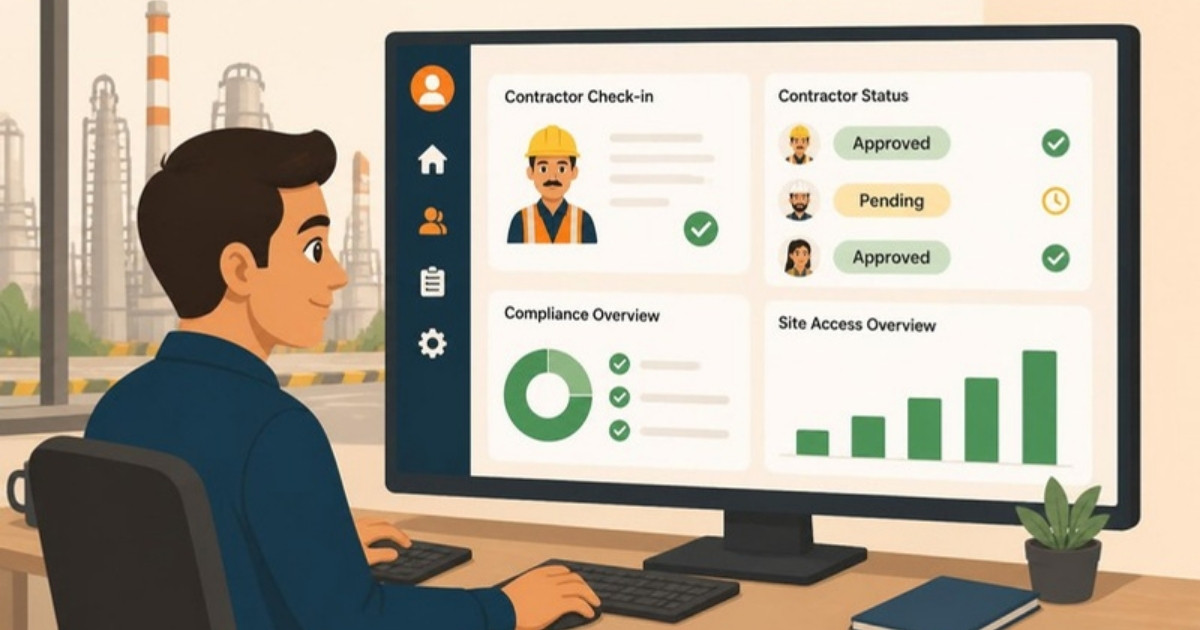
Be clear-eyed about this, because vendor content in this space routinely over-claims.
What a gate and visitor management system genuinely does well
- Identity capture and OTP verification at entry
- Passes that persist across visits, so daily-entry contractors are not re-registered every morning VizMan’s factories solution issues multi-visit passes for contractors and vendors for exactly this reason
- Role-based access, so security, reception, EHS and host see appropriate views
- Blocked-list enforcement, so a worker who should not enter does not
- Exportable, timestamped entry/exit logs the raw material of your audit pack and your evacuation list
- Operation at the gate on a phone or tablet, including where connectivity is unreliable
What it does not replace
The induction content itself (delivering and testing the training usually sits in an LMS or classroom), the permit-to-work system, competency assessment, or your contract labour payroll and statutory return filing.
Questions to ask any vendor, including us
Can the system store a document expiry date against a worker and act on it? Can a contractor-level expiry cascade to that contractor’s workers? Can security see the block reason without seeing the underlying medical record? Can I export a live on-site list during an evacuation? What happens when the gate loses internet? Where is the data stored, and what is the retention policy?
That last one is not optional. Contractor records are personal data, and access control, logging and retention are design decisions you make now, not later.
A 30-day rollout for one gate
Do not boil the ocean. Pick your highest-traffic contractor gate and prove the model.
- Days 1–5. Count the real population: how many contract workers, how many contractors, peak arrivals per 15 minutes at shift change.
- Days 6–10. Fix the document master list which documents you track, their validity rules, and the graded gate action for each.
- Days 11–15. Digitise the existing induction register. Every worker gets a record with a real expiry date, no blanks.
- Days 16–20. Issue passes linked to those records. Run parallel with the paper register; do not switch yet.
- Days 21–25. Enforce one rule only expired induction. Measure the queue. Fix throughput before adding rules.
- Days 26–28. Add the remaining document expiry rules one at a time.
- Day 29. Run an unannounced evacuation drill. Time how long the on-site contractor list takes to produce.
- Day 30. Retire the paper register at that gate. Write down what broke, then plan gate two.
The measure of success is not “we bought software.” It is that the 6:00am queue moves as fast as before, and the 14:30 roll call is accurate.
